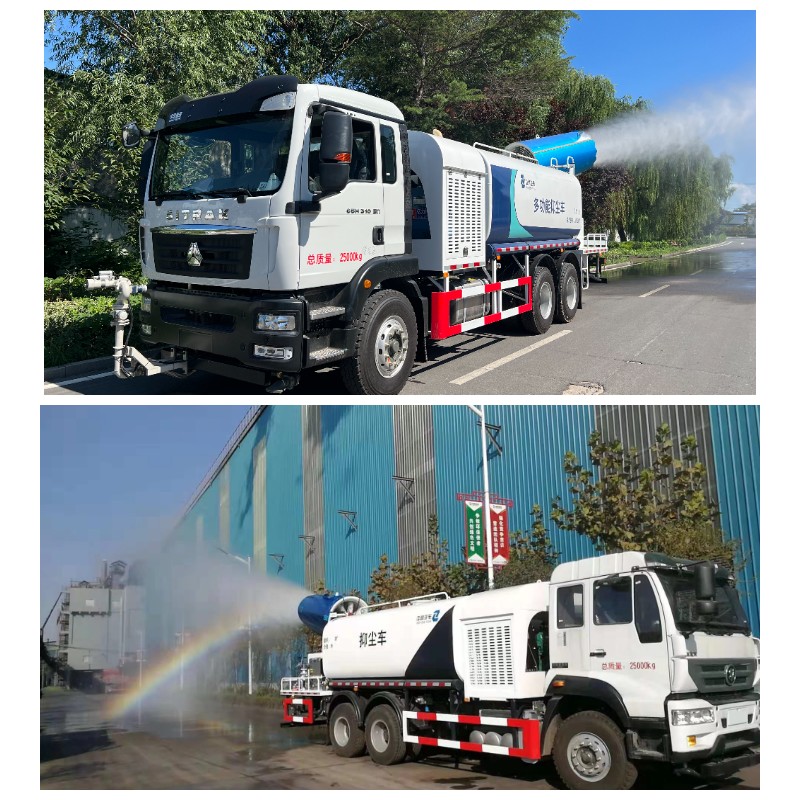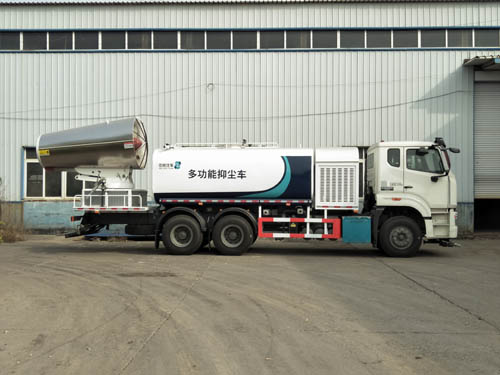
Fog Cannon Truck
1.The ultra-fine mist droplets can firmly absorb dust and PM2.5, with much higher efficiency than ordinary sprinkling.
2.Saves 70%–80% more water than traditional sprinkler trucks, enabling longer working hours and larger coverage with the same water volume.
3.Can spray from dozens to over 100 meters, covering high-altitude, long-distance and large-area areas.
4.Sprays in mist form, leaving almost no water on the road, without affecting traffic or wetting pedestrians and vehicles.
5.Used for dust suppression, cooling, humidification, greening spraying, disinfection and deodorization.
A Fog Cannon Truck (also called mist cannon truck, dust suppression truck) is a specialized municipal/industrial vehicle equipped with a large, long-range spray cannon to atomize water (or water+dust suppressant) into fine mist for dust control, air purification, cooling, and disinfection.
Core Structure & Working Principle
1.Chassis & Tank: Based on a heavy-duty truck chassis, with a water tank (often 5–15 m³) and a dedicated power unit (diesel generator) for the fog cannon.
2.Fog Cannon Assembly: Includes a high-pressure pump, axial fan, adjustable nozzle ring, and hydraulic/pneumatic tilting & 360° rotating mechanism. It turns water into 10–50 μm mist droplets, then blows them far via strong airflow.
3.Control System: Manual, cab-integrated, or wireless remote control for spray volume, angle, and on-the-move operation.
4.Auxiliary Sprinklers: Front/rear/side nozzles for regular road washing and greening irrigation.
Key Performance & Types
1.Range: Small (20–50 m, urban streets); medium (50–100 m, construction sites/quarries); large (100+ m, ports/coal yards).
2.Water Efficiency: Uses 70–80% less water than conventional sprinklers, avoiding road puddles.
3.Power Options: Diesel (most common), electric (new energy, zero-emission for cities).
Typical Applications
1.Urban road & construction site dust/PM2.5 suppression;
2.Open stockpiles (coal, ore, aggregates) dust control;
3.Port, railway terminal, and mine haul road dust reduction;
4.Outdoor venue cooling (plazas, stadiums);
5.Public area disinfection (with disinfectant added).